







Welcome
Welcome to my academic website. This website provides an overview of my research, teaching, publications, software developments, and academic activities in the broad field of structural engineering.
My research is primarily devoted to the development of computational methodologies and advanced numerical techniques for understanding and solving complex engineering problems. Particular emphasis is placed on computational mechanics, finite element analysis, structural optimization, structural dynamics, nonlinear behavior, scientific computing, and their applications to challenging engineering systems.
Throughout my academic career, I have sought to bridge fundamental scientific research with engineering practice by developing rigorous mathematical models, efficient computational algorithms, and reliable numerical methodologies. My work spans from methodological advances in computational mechanics to the analysis, design, optimization, and performance assessment of structural systems subjected to complex loading and environmental conditions.
In addition to research, this website provides access to publications, educational resources, software projects, and information about current and former students. I hope these materials contribute to the dissemination of knowledge in computational structural engineering and prove useful to researchers, graduate students, practicing engineers, and anyone with an interest in this field.
A Philosophy of Research
The following passage from Leonhard Euler has profoundly influenced my scientific view of mathematics, engineering, and the pursuit of knowledge.
Cum enim Mundi universi fabrica sit perfectissima atque a Creatore sapientissimo absoluta, nihil omnino in mundo contingit, in quo non maximi minimive ratio quaepiam eluceat; quamobrem dubium prorsus est nullum, quin omnes Mundi effectus ex causis finalibus ope Methodi maximorum et minimorum aeque feliciter determinari queant, atque ex ipsis causis efficientibus.
For since the fabric of the universe is most perfect and is the work of a most wise Creator, nothing at all takes place in the universe in which some rule of maximum or minimum does not appear. Therefore there is absolutely no doubt that every effect in the universe can be determined as satisfactorily from final causes, by the aid of the method of maxima and minima, as from the effective causes themselves.
Leonhard Euler - Methodus Inveniendi Lineas Curvas Maximi Minimive Proprietate Gaudentes, sive Solutio Problematis Isoperimetrici Latissimo Sensu Accepti (1744), Additamentum I: De Curvis Elasticis, §1, Euler Archive
The words of Euler have long resonated with my own view of science. They express a conviction that the physical world is neither arbitrary nor chaotic, but governed by an underlying mathematical order whose principles can be discovered through careful observation, rigorous reasoning, and scientific inquiry. To me, research is fundamentally a journey toward understanding that order.
Mathematics is therefore far more than a computational instrument; it is the language in which nature expresses its coherence. Every mathematical model, numerical algorithm, optimization procedure, or computational method represents an attempt not merely to calculate, but to reveal a small part of the structure that governs physical phenomena. Engineering research, in this sense, is a process of discovery rather than invention.
This conviction has shaped my research throughout my academic career. Rather than pursuing isolated solutions to individual engineering problems, I have consistently sought to develop computational methodologies that are sufficiently general to explain broad classes of structural behavior. Computational mechanics, finite element methods, adaptive numerical algorithms, structural optimization, nonlinear dynamics, scientific computing, artificial intelligence, and high-performance computing are therefore not independent disciplines in my research. Together, they form an integrated framework for discovering, modeling, predicting, and understanding increasingly complex engineering systems through mathematics.
This integrated perspective has naturally led to research spanning structural engineering, steel and concrete structures, structural dynamics, earthquake engineering, vortex-induced vibrations, stability analysis, optimization, and scientific software development. Although these applications appear diverse, they remain connected by a single objective: to uncover the mathematical principles that govern physical behavior and to transform that understanding into reliable, efficient, and practically useful computational methodologies.
Every research problem solved is, to me, another small step toward revealing the hidden mathematical order embedded in the universe. Yet the deepest satisfaction does not come from solving one more engineering problem or applying a familiar method once again. It comes from those rare moments when phenomena that initially seem entirely unrelated suddenly reveal a common mathematical structure. In those moments, complexity gives way to clarity, diversity gives way to unity, and mathematics ceases to be merely a computational tool—it becomes a language through which the hidden coherence of nature gradually unfolds. Those moments of discovery are, to me, the true reward of scientific research.
Viewed from this perspective, computation is valuable not because it produces larger datasets or faster numerical results, but because it extends our ability to explore and understand the mathematical order of the physical world. Numerical methods, software development, artificial intelligence, and high-performance computing are therefore not the destination of research, but the instruments through which scientific understanding advances.
The purpose of computing is insight, not numbers.
Richard W. Hamming - ACM A.M. Turing Award Biography
Research Framework
My research is driven by the development of rigorous computational methodologies for understanding and solving complex engineering problems. Although the topics presented on this website span computational mechanics, structural optimization, nonlinear structural dynamics, and engineering applications, they are united by a common objective: advancing reliable mathematical and numerical frameworks that transform fundamental scientific principles into practical engineering solutions.
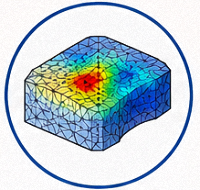
Adaptive Computational Mechanics
Developing advanced computational methodologies for adaptive finite element analysis, error estimation, mesh refinement, data transfer, and high-performance computing.
- Adaptive FEM
- Error Estimation
- Mesh Adaptation
- Parallel Computing
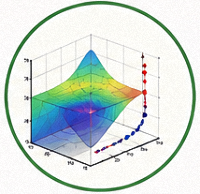
Optimization & Computational Intelligence
Integrating computational mechanics with optimization, intelligent algorithms and performance-based engineering.
- Optimization
- Metaheuristics
- Machine Learning & AI
- Optimal Design
- Optimal Control
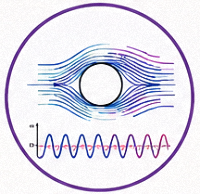
Nonlinear Structural Dynamics
Understanding nonlinear structural response through numerical simulation of vibration, instability and fluid–structure interaction.
- Vortex-Induced Vibrations
- Chaotic Structural Response
- Fluid–Structure Interaction
- Dynamic Stability
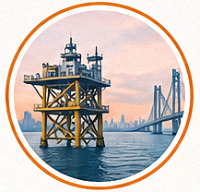
Engineering Applications
Applying computational methodologies to real engineering systems including steel structures, offshore platforms, reliability and scientific software.
- Steel Structures
- Reliability
- High-Performance Computing
- Scientific Software
Adaptive Computational Mechanics
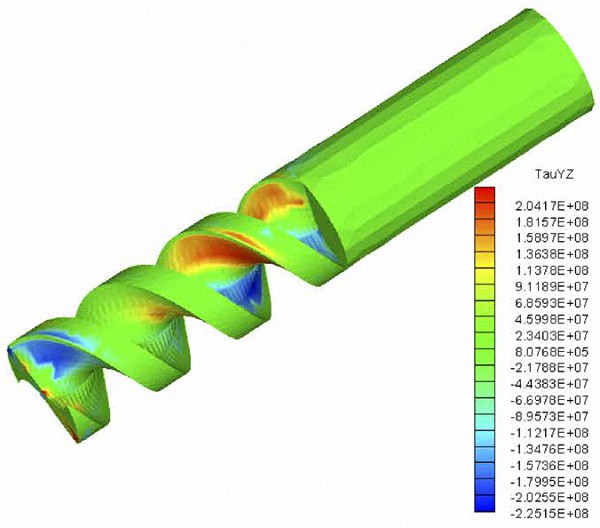 3D Recovery-based data transfer
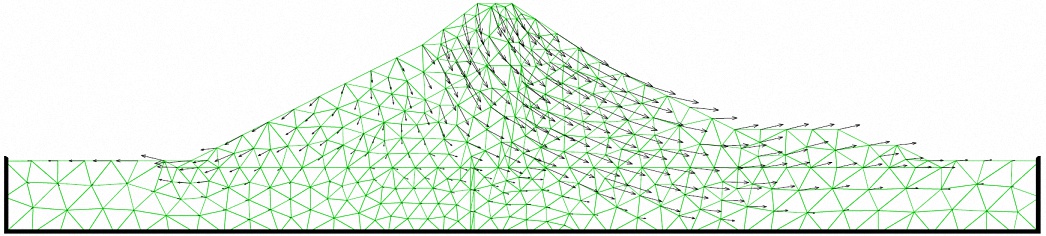
Adaptive computational mechanics constitutes the foundation of my research. Rather than employing finite element analysis simply as a numerical tool, my work focuses on advancing the underlying computational methodologies through adaptive mesh refinement, recovery-based error estimation, efficient solution-transfer algorithms, and scalable parallel computing. These developments aim to improve the accuracy, robustness, and computational efficiency of large-scale structural simulations while preserving their practical applicability to engineering analysis.
Particular emphasis has been placed on developing integrated computational frameworks in which adaptive analysis proceeds automatically through successive cycles of error estimation, mesh refinement, solution transfer, and numerical verification. A central component of this research has been the development and extension of the Superconvergent Patch Recovery (SPR) technique for three-dimensional problems, enabling accurate error estimation, reliable adaptive mesh refinement, and efficient data transfer between successive computational meshes.
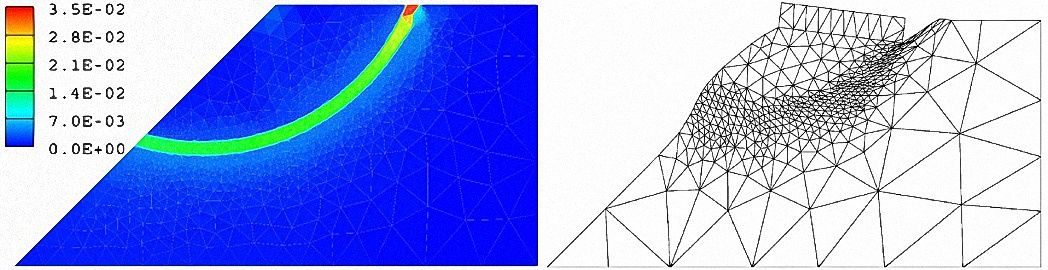 Error estimation and mesh refinement
As computational models continue to increase in scale and complexity, efficient parallel computing has become an integral part of modern computational mechanics. My research in this area has focused on developing scalable parallel algorithms for finite element analysis, with particular emphasis on computational efficiency, load balancing, communication optimization, and high-performance implementations capable of addressing large-scale engineering simulations.
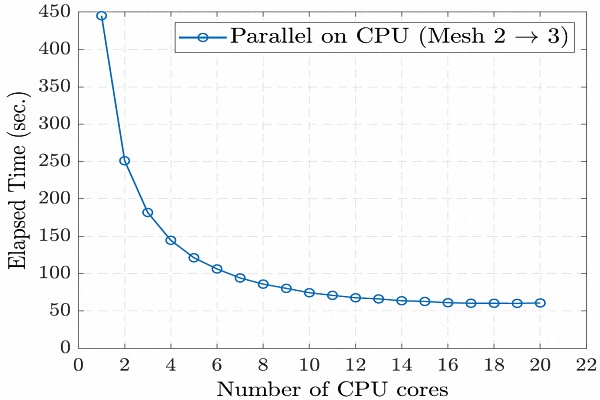 Parallel computation on CPU
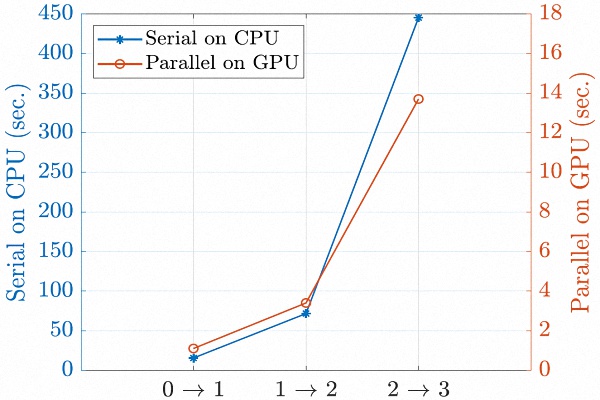 Parallel computation on GPU
The culmination of these research efforts is the development of a Python-based computational framework for adaptive finite element analysis. By integrating adaptive mesh refinement, error estimation, parallel computing, solution-transfer techniques, and scientific visualization within a unified environment, this software provides a practical platform that bridges methodological research with large-scale engineering applications.
Representative Research Topics
- Adaptive Finite Element Analysis
- Error Estimation and Recovery Methods
- Adaptive Mesh Refinement
- Superconvergent Patch Recovery (SPR)
- Parallel Finite Element Computing
- High-Performance Scientific Computing
Representative Publications
Optimization & Computational Intelligence
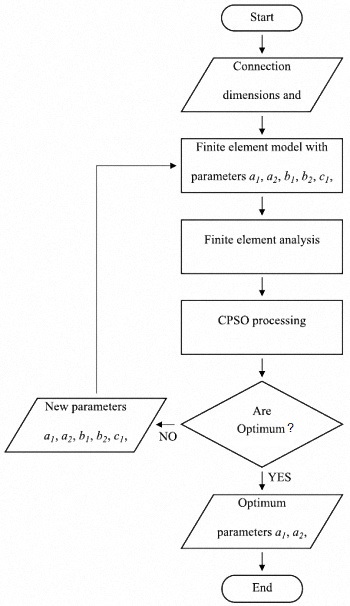 DRBS optimization methodology
Building upon advances in computational mechanics, this research theme investigates how rigorous numerical methodologies can be transformed into practical tools for engineering design and decision-making. Rather than treating structural analysis and optimization as independent processes, my research integrates them within unified computational frameworks capable of improving structural performance while simultaneously satisfying engineering, economic, and computational constraints.
My work in this area encompasses structural optimization, intelligent computational methods, performance-based design, and structural control. The emphasis has consistently been placed on developing robust and transferable computational methodologies whose applicability extends well beyond individual engineering problems. As a result, the proposed approaches provide general computational strategies that can be adapted to a broad spectrum of structural engineering applications requiring reliable decision support.
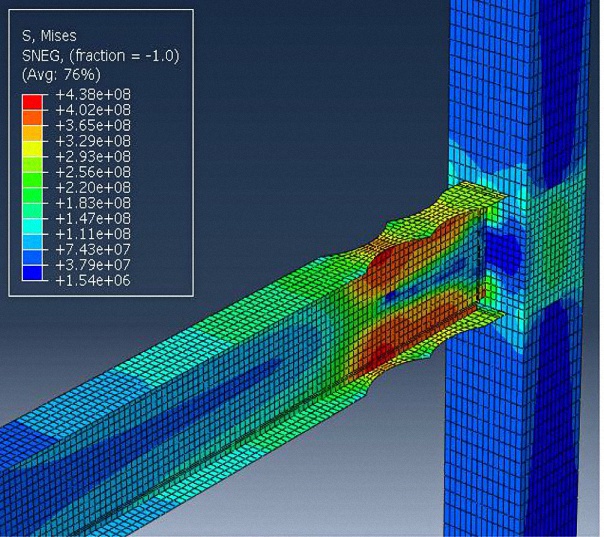 Performance-based optimum design
Performance-based design provides a natural framework in which computational optimization can be translated into practical engineering solutions. My research has focused on developing computational frameworks capable of automatically identifying optimal structural configurations while satisfying multiple performance objectives under diverse loading conditions.
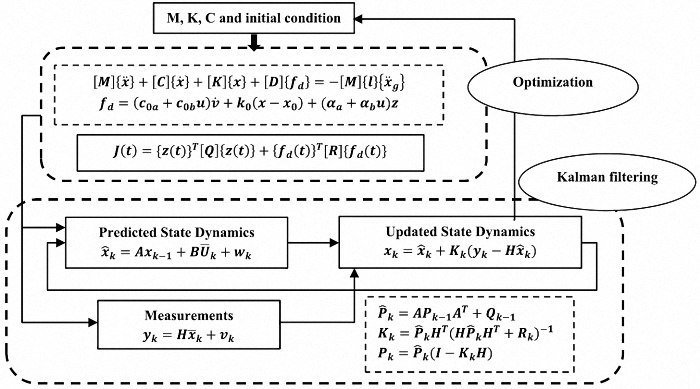 Intelligent computational strategy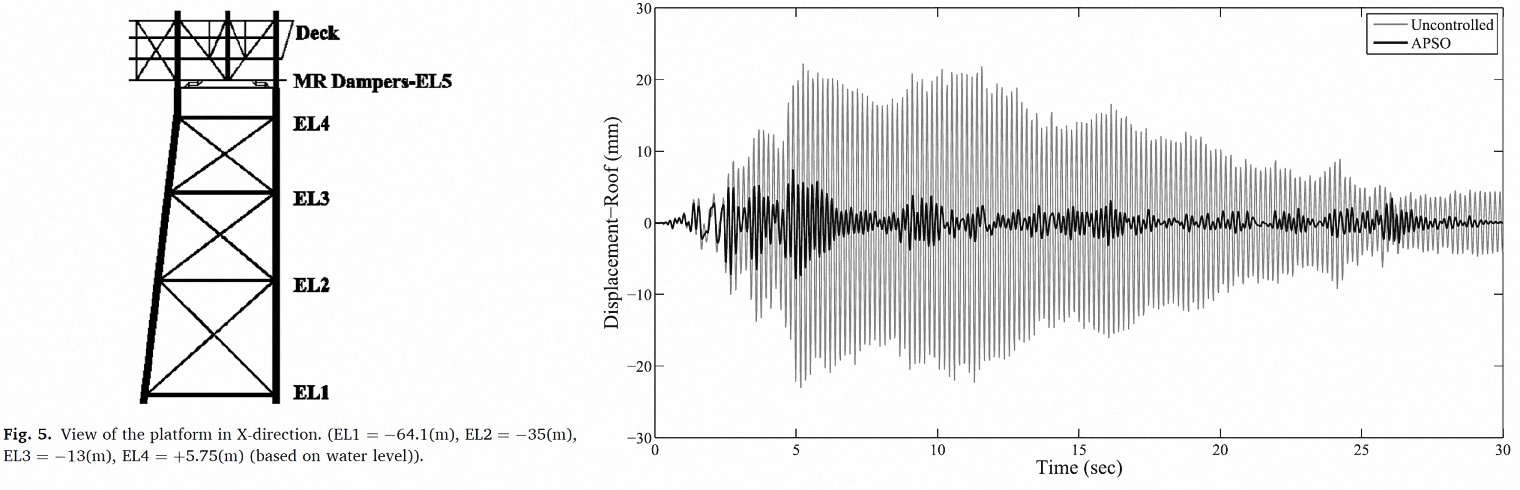
Optimal control of structures represents a further extension of these optimization methodologies toward real-time engineering decision-making. My research has investigated both active and semi-active control systems, with particular emphasis on the optimal placement of control devices and the integration of intelligent computational techniques for achieving reliable and efficient structural performance under dynamic loading.
Representative Research Topics
- Structural Optimization
- Optimal Design of Structures
- Intelligent Computational Methods
- Metaheuristic Optimization Algorithms
- Optimal Control of Structures
- Machine Learning & AI
Representative Publications
Nonlinear Structural Dynamics
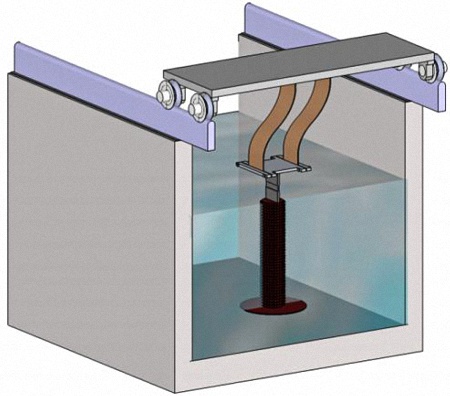 Schematic view of the experiment
Nonlinear structural dynamics represents a natural extension of the computational methodologies developed in the preceding research themes. My research investigates the response of structural systems subjected to dynamic and environmental loading, with particular emphasis on nonlinear behavior, vibration mechanisms, stability, and fluid-structure interaction. These phenomena are studied within a unified computational framework that combines advanced numerical simulation with physical insight into complex dynamic behavior.
My research has extensively investigated nonlinear vibration phenomena, vortex-induced vibrations, chaotic structural response, and dynamic instability. Beyond predicting structural behavior, these studies seek to reveal the fundamental physical mechanisms governing complex dynamic systems. By integrating computational mechanics with nonlinear dynamics, this work contributes to a deeper understanding of structural performance under realistic operational and environmental conditions.
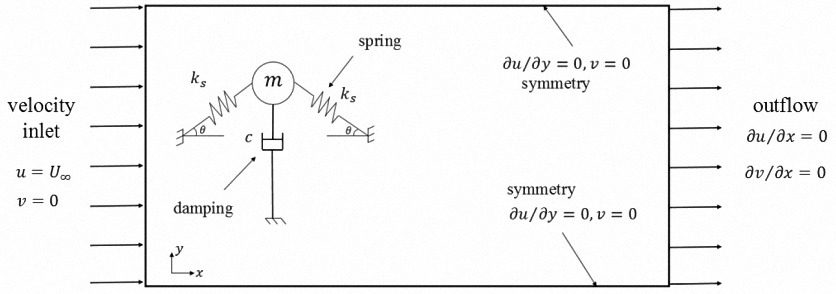 Mathematical model for rigid cylinder with nonlinear snapping support
Vortex-induced vibrations represent one of the most challenging fluid-structure interaction problems in engineering. My research has investigated the complex dynamic behavior of cylindrical structures subjected to flow, with particular emphasis on the transition from periodic to chaotic response and the influence of support conditions on vibration characteristics.
Fluid-structure interaction forms an essential component of many nonlinear engineering systems. My research has focused on developing efficient partitioned computational strategies that combine advanced fluid solvers with robust structural models, enabling accurate simulation of vortex-induced vibrations and other complex coupled dynamic phenomena.
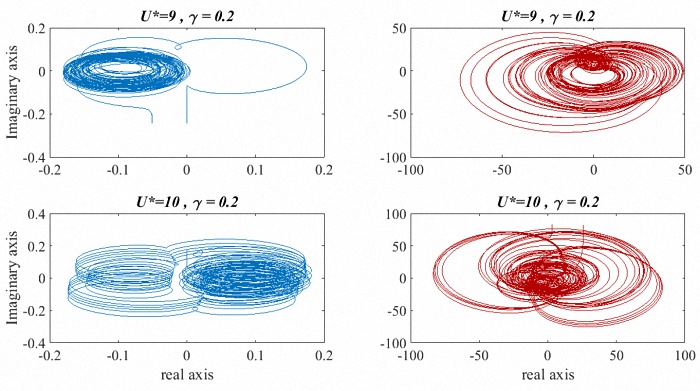
Chaotic behavior, although often associated with undesirable structural response, provides valuable insight into the fundamental mechanisms that govern nonlinear dynamic systems. My research explores the detection, characterization, and interpretation of chaotic behavior as a means of advancing the understanding of complex structural dynamics and supporting more reliable engineering predictions.
Representative Research Topics
- Nonlinear Dynamics
- Fluid-Structure Interaction
- Vortex-Induced Vibrations
- Dynamic Stability
- Chaotic Structural Response
- Snap-Through Systems
Representative Publications
Engineering Applications
Engineering applications represent the culmination of my research rather than its starting point. They are not presented merely as numerical examples or validation studies, but as demanding environments in which newly developed computational methodologies are evaluated against the complexity of real engineering systems. Their purpose is to demonstrate that rigorous mathematical models and numerical algorithms remain reliable when nonlinear behavior, uncertainty, deterioration, and large-scale computation become dominant features of practical engineering problems.
Although these applications span diverse branches of structural and computational engineering, they share a common methodological foundation built upon adaptive finite element analysis, nonlinear simulation, probabilistic modeling, structural reliability, optimization, and high-performance scientific computing. Rather than developing isolated application-specific procedures, my objective has been to establish computational methodologies whose validity extends across a broad spectrum of engineering systems while preserving both mathematical rigor and practical engineering relevance.
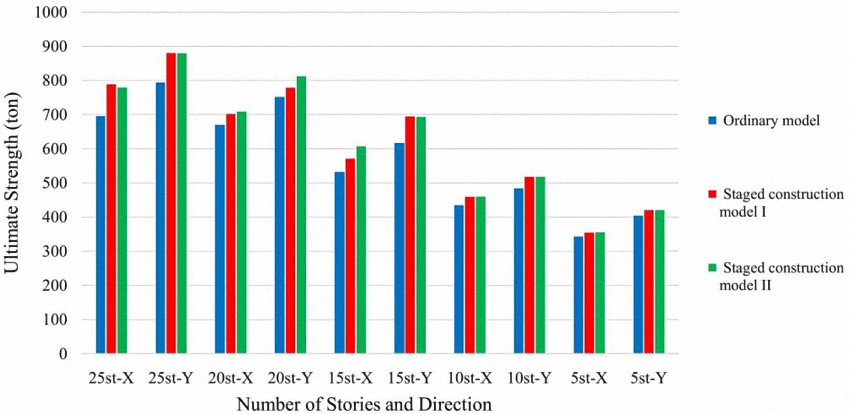
Steel structural systems have provided one of the principal platforms for validating these methodologies. My research has addressed nonlinear seismic behavior of steel moment-resisting and dual systems, staged-construction effects, innovative shear fuse systems for energy dissipation, optimization of steel connections, and performance-based structural evaluation. Collectively, these studies demonstrate how computational mechanics can support both structural understanding and informed engineering decision-making under severe loading conditions.
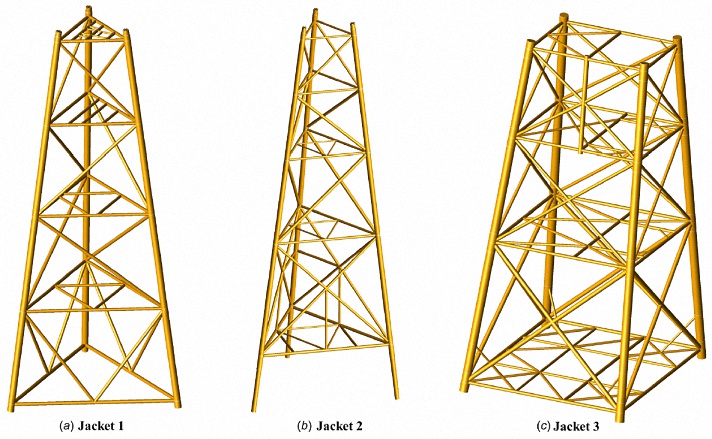
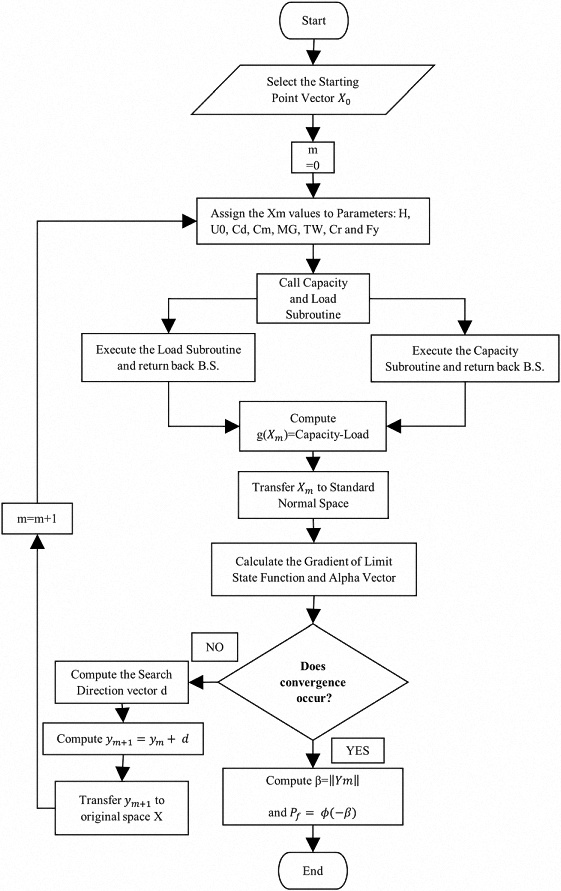
A complementary line of research concerns offshore steel infrastructure, where uncertainty becomes an inherent component of engineering practice. My work integrates probabilistic corrosion models, Bayesian reliability updating, and reliability-based inspection planning into unified computational frameworks for jacket platforms. These methodologies provide quantitative tools for predicting structural deterioration, optimizing inspection strategies, and improving life-cycle management under uncertain environmental conditions.
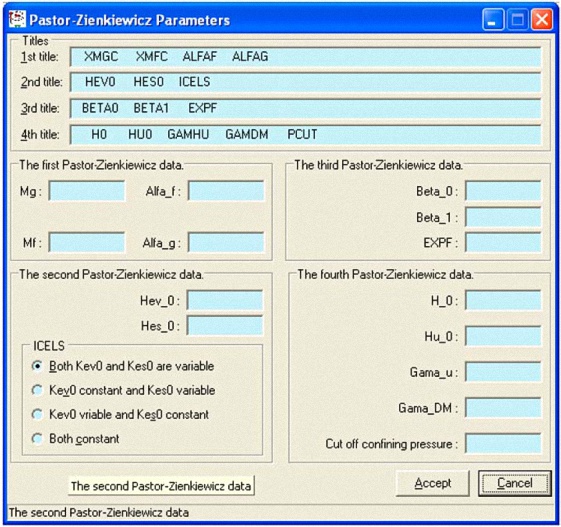
Scientific software development represents a natural extension of this research philosophy. Rather than implementing isolated numerical algorithms, projects such as PyAdMesh and SUT-DAM have been developed as integrated computational platforms through which advanced engineering methodologies become accessible for large-scale scientific computing and multidisciplinary engineering analysis. These software environments translate mathematical concepts into practical technologies that support both academic research and professional engineering practice.
Viewed collectively, these engineering investigations are united by a single objective: transforming rigorous computational methodologies into dependable engineering technologies. Whether the problem involves seismic performance of steel structures, offshore infrastructure, reliability-based engineering decisions, or high-performance scientific software, the underlying philosophy remains unchanged. Engineering applications are not simply the destination of computational research—they are the ultimate demonstration that sound mathematical methodologies can reliably describe, predict, and support decisions in complex real-world engineering systems.
Representative Engineering Research Areas
- Performance-Based Seismic Engineering
- Steel Structural Systems
- Structural Reliability and Probabilistic Engineering
- Bayesian Reliability Updating
- Offshore Steel Structures
- Scientific Software Development
- High-Performance Engineering Computing
- Computational Geotechnics